

End-to-End Peptide Drug Conjugate Development Services: From Design to GMP Manufacturing
End-to-End Peptide Drug Conjugate Development Services: From Design to GMP Manufacturing
Description: Learn how end-to-end peptide drug conjugate development connects molecular design, peptide synthesis, conjugation, analytical development, scale-up, CMC and GMP manufacturing.
Peptide drug conjugates (PDCs) combine a peptide, linker and functional payload within a single molecular construct. Their development is more complex than simply synthesizing these components and connecting them. Changes in peptide sequence, conjugation site, linker chemistry or payload can affect biological activity, solubility, stability, purification and manufacturability at the same time. [1-5]
For this reason, end-to-end PDC development should connect molecular design, peptide synthesis, conjugation, analytical characterization, process development, scale-up, CMC and GMP manufacturing as one development strategy.
This article examines the main challenges in PDC developability, process and analytical development, scale-up and CMC readines, and how development continuity can support the transition from early design to GMP manufacturing.
PDC Development Requires the Peptide, Linker and Payload to Work as One System
A PDC typically contains three functional elements: peptide + linker + payload. The peptide may provide receptor recognition, tissue targeting or cellular penetration. The linker connects the components and may influence systemic stability and payload release. The payload provides the intended pharmacological activity.
These components cannot be optimized independently. A hydrophobic payload may reduce the solubility of an otherwise soluble peptide. Moving the conjugation site may improve chemical accessibility while affecting receptor binding. A linker that is too unstable may release the payload prematurely, while excessive stability may limit release at the intended site. [1-4]
A biologically active PDC is not necessarily a developable PDC.
The more relevant development question is whether the complete molecule can retain the required biological performance while also being synthesized, purified, characterized and manufactured reproducibly.
End-to-End PDC Development Connects Design with Scalable Manufacturing
Early programs may evaluate peptide sequence, cyclization, stereochemistry, conjugation position, linker type and payload attachment before selecting a lead construct. Once a candidate advances, the chemistry must transition from a discovery procedure that works to a process that can be controlled and reproduced.
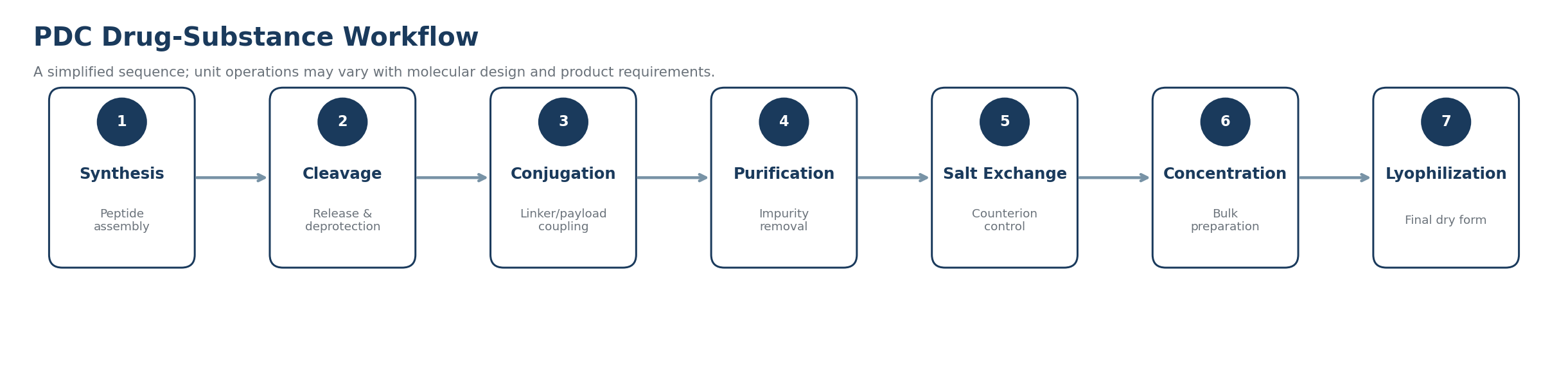
Figure 1. Simplified PDC drug-substance workflow. Individual unit operations and their sequence may vary with peptide structure, conjugation chemistry, payload properties and product requirements.
The workflow is connected: synthesis and cleavage conditions influence the impurity profile entering conjugation, while conjugation can change hydrophobicity and chromatographic behavior and therefore affect downstream purification and recovery.
Three Development Risks Shape PDC Developability
1. Peptide, Linker and Payload Properties Must Be Balanced
Candidate selection should consider biological performance and chemical developability in parallel. Peptide modifications used to improve stability or pharmacokinetics may increase synthetic complexity; linker design must balance stability with the intended release mechanism; and payload properties can alter solubility, aggregation and purification behavior. [1-5]
2. Purification and Impurity Control Affect Scalability
PDCs can contain peptide-related impurities such as deletion or insertion sequences, epimers, oxidation products and incorrectly connected species, while conjugation can introduce unreacted peptide, linker-related species, free payload and conjugation-derived impurities. Closely related species can be difficult to separate, making purification a development activity rather than a final clean-up step.
3. Scale-Up Requires Process Reassessment
Discovery synthesis is optimized to obtain material for testing. Development-scale synthesis must deliver reproducible yield and quality. Resin characteristics, coupling conditions, reagent ratios, mixing, cleavage, preparative chromatography loading, solubility and recovery may all require reassessment as scale increases.
Analytical Development Should Begin Early
A development-oriented analytical strategy should answer four questions:
HPLC and UPLC can support purity assessment and process monitoring, while LC-MS and high-resolution mass spectrometry can support identity and impurity characterization. Depending on the molecule and development stage, additional studies may address sequence confirmation, stereochemistry, residual solvents, elemental impurities, counterions, water content and stability.
CMC And Manufacturability Should Be Considered Before Late-Stage Development
Formal CMC development expands as a candidate approaches clinical development, but manufacturability should be considered earlier. ICH Q11 emphasizes developing understanding of the manufacturing process and its relationship to drug-substance quality. [6] For peptide and PDC programs, this can ultimately include controls around starting materials, synthesis parameters, purification, analytical methods, specifications and stability.
The goal is not to impose late-stage requirements on discovery. It is to avoid selecting a molecule or process that creates unnecessary downstream risk.
A Practical PDC Development Decision Framework
| Development Question | Why It Matters |
|---|---|
| Is the peptide sufficiently stable? | Stability can affect exposure and biological performance. |
| Is linker behavior appropriate for the intended mechanism? | Premature or insufficient release may compromise performance. |
| Can the conjugate be purified efficiently? | Purification directly affects scalability and manufacturing economics. |
| Are critical impurities understood? | Impurity knowledge supports process optimization and CMC control. |
| Can the process progress beyond milligram scale? | Scale-up feasibility is part of overall developability. |
Integrated CRO/CDMO Model Preserves Process Knowledge
A PDC program may involve peptide synthesis, linker or payload chemistry, conjugation, purification, analytical development and GMP manufacturing. When these activities are split across multiple organizations, each technology transfer can lose practical knowledge about sensitive coupling steps, failed conditions, difficult impurities, solubility limits or purification behavior.
The main advantage of an integrated model is therefore development continuity: preserving molecular and process knowledge as the candidate moves from discovery into process development and manufacturing.
How ChemExpress Supports End-to-End PDC Development
ChemExpress has established an integrated peptide platform covering research synthesis, process development, analytical development, CMC support and GMP manufacturing.
Platform data report experience across:
Technical capabilities include solid-phase and liquid-phase peptide synthesis; linear, cyclic, bicyclic and stapled peptides; PDCs; peptide precursors used in radionuclide drug conjugate programs; and modifications such as PEGylation, biotinylation, fluorescent labeling and chelator installation.
Development-stage support extends into process optimization, preparative purification, lyophilization, impurity investigation, analytical method development and validation, stability studies, quality control, CMC and GMP manufacturing.
Experience in Practice
ChemExpress platform experience includes PDC-related projects and larger-scale cyclic and modified peptides. One PSMA-targeting radioligand precursor project highlighted practical issues including high material cost, poor solubility during purification and limited stability. These challenges illustrate why successful conjugation alone is not sufficient: raw-material strategy, purification, solubility, stability and reproducibility can determine whether a candidate is developable.
Conclusion
Peptide drug conjugates offer a flexible approach to targeted drug delivery, but their modular design creates interconnected development challenges. Peptide sequence, linker chemistry and payload selection influence not only biological performance but also synthesis, solubility, purification, impurity formation and scale-up.
Successful PDC development therefore requires a pathway that can transform a biologically promising molecule into a reproducible, characterized and scalable drug substance.
Frequently Asked Questions
Q1: What is an end-to-end PDC development service?
A: It connects peptide synthesis and conjugation with analytical development, process optimization, scale-up, CMC and GMP manufacturing so that product and process knowledge can be preserved as the candidate advances.
Q2: When should process development begin for a PDC?
A: Developability should be considered during candidate selection, even if formal process development starts later. Early information on crude purity, solubility, conjugation behavior and purification can identify candidates that may become difficult to manufacture.
Q3: Why is analytical development important for PDCs?
A: PDCs can contain peptide-related, stereochemical, linker-related, payload-related and degradation impurities. Understanding these species helps identify process weaknesses and supports later specifications, stability studies and manufacturing controls.
Q4: Can a PDC process be scaled directly from milligrams to kilograms?
A: Usually not by simple proportional scale-up. Reaction conditions, mixing, purification loading, solubility, impurity clearance and lyophilization may all need optimization as batch size increases.
Q5: What should sponsors look for in an end-to-end PDC partner?
A: Evaluate peptide chemistry, conjugation, purification, analytical science, scale-up, CMC and GMP capabilities together, and assess whether these functions communicate effectively throughout the project lifecycle.
References
1. Armstrong A, Coburn F, Nsereko Y, Al Musaimi O. Peptide-Drug Conjugates: A New Hope for Cancer. Journal of Peptide Science. 2025;31(8):e70040.
2. Fajar M, Maharani R, Supratman U. Linkers for effective peptide-drug conjugates. Bioorganic & Medicinal Chemistry. 2026;133:118510.
3. Jin H, Yang P, Min H, Song J, Qi Y. Peptide-drug conjugates in tumor therapy: Current advances and future perspectives. Cancer Letters. 2026;638:218174.
4. Rizvi SFA, Zhang L, Zhang H, Fang Q. Peptide-Drug Conjugates: Design, Chemistry, and Drug Delivery System as a Novel Cancer Theranostic. ACS Pharmacology & Translational Science. 2024;7(2):309-334.
5. Fu C, Yu L, Miao Y, Liu X, Yu Z, Wei M. Peptide-drug conjugates (PDCs): a novel trend of research and development on targeted therapy, hype or hope?. Acta Pharmaceutica Sinica B. 2023;13(2):498-516.
6. International Council for Harmonisation. ICH Q11: Development and Manufacture of Drug Substances. ICH Quality Guidelines. Current official guideline page.