
Photochemistry
Compared to traditional thermochemical reactions, photochemical reactions offer the advantages of energy efficiency, environmental friendliness, and cost-effectiveness. Among its key applications, photocatalysis utilizes photocatalysts to accelerate chemical reactions. However, conventional batch photoreactors are limited by light penetration depth and mass transfer efficiency, making it difficult to scale up photocatalytic processes.
ChemExpress' photocatalytic continuous flow platform combines continuous flow technology with photocatalytic reactions. Through microreactor design, high-efficiency light sources, and precise process control, the platform overcomes the scale-up challenges of conventional batch photoreactors, supporting process development from milligram- to gram-scale, as well as kilogram- to hundred-kilogram-scale production.
What We Can offer
- Process Route Exploration & Optimization
- Screening and optimization of photocatalytic process parameters
- Conversion to photocatalytic continuous flow process
- Scale-up equipment design and fabrication
- Technology Transfer
- Technical documentation for process parameter development
- Process solutions and technical expertise
- Custom Development & Manufacturing
- Custom synthesis of photocatalytic reaction products
- Scaled production of photocatalytic reaction products
Reaction Types
- Ring-Opening Reaction
- Photoredox Reaction
- Photoinitiated Free Radical Reaction
- Photoisomerization Reaction
- Photooxidation Reaction
Why Partner with ChemExpress
Extensive Process Experience
With nearly 20 years of process development expertise, our team specializes in diverse photocatalytic reaction systems and has extensive experience in photocatalytic continuous flow technology — including the design and fabrication of optimized reactors tailored to specific reaction parameters
Integrated Synthesis Capability
Leveraging extensive experience in chemical synthesis, particularly in complex molecule synthesis, ChemExpress integrates photocatalytic reactions with chemical synthesis to support integrated project delivery

Professional Equipment
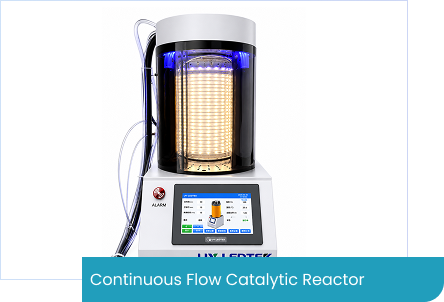
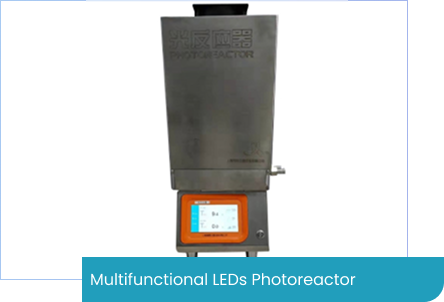
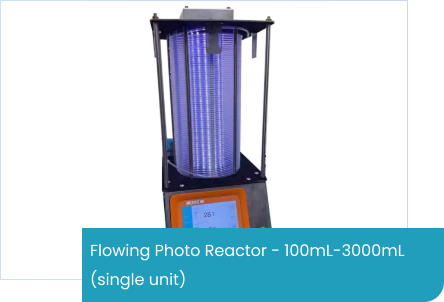
ChemExpress is equipped with parallel photoreactors covering multiple wavelength bands between 200–700 nm for efficient spectral screening, along with in-house developed continuous-flow photocatalytic systems (immersion-type, stirred tank, microchannel configurations) to support efficient scale-up manufacturing
Key Equipment
Case Study
Photocatalytic Radical Addition
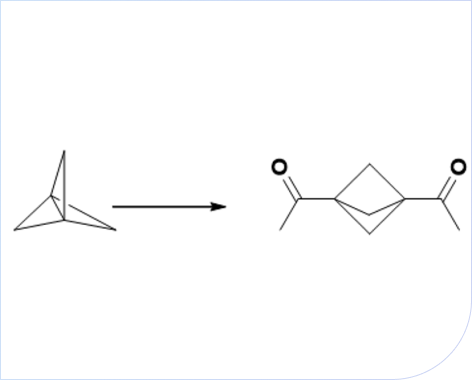
Background: Bicyclo[1.1.1]pentane (BCP), with its three-dimensional ring skeleton, is favored by pharmaceutical chemists for its distinctive physicochemical properties, including low lipophilicity and enhanced electronegativity. ChemExpress has developed a series of BCP products.
Achievement: Using in-house developed photocatalytic equipment, ChemExpress successfully applied photocatalytic continuous-flow technology to the reaction of BCP with 2,3-butanedione, reducing irradiation time to 10 minutes and achieving a yield of 85–90%. This enabled hundred-kilogram-scale production of 1,3-diacetyl bicyclo[1.1.1]pentane.
FAQs
Photochemical reactions are chemical reactions initiated by visible light or ultraviolet irradiation. Unlike conventional thermal reactions, photochemical reactions generally proceed under ambient or low-temperature conditions, offering a milder, more energy-efficient, and environmentally friendly approach — particularly suited for thermally sensitive substrates or reaction systems requiring unique activation pathways.
Different substrates exhibit significant differences in light absorption characteristics; only upon absorbing photons at specific wavelengths can a substrate be activated to an excited state and undergo chemical transformation. However, even for the same substrate, different wavelengths of irradiation may trigger entirely different reaction pathways. Therefore, screening for the optimal irradiation wavelength for a given reaction system is a critical step in photocatalytic process development.
ChemExpress provides parallel photoreactors covering multiple wavelength bands between 200–700 nm to support efficient wavelength screening and process optimization, helping improve reaction efficiency and selectivity.
The implementation of microchannels in photocatalytic continuous-flow reactors significantly enhances light-exposed surface area and mass transfer efficiency. The shortened optical path length ensures uniform light distribution, minimizing side reactions, simplifying product purification, and improving yield. This technology enables scalable production while meeting the stringent requirements of industrial-scale manufacturing.


