

One-Stop ADC
CDMO Service
ChemExpress offers integrated services spanning from Payload-Linker to ADC DS&DP, enabling efficient scale-up and seamless technology transfer, effectively reducing management and transition costs.

Extensive Project Experience
& Comprehensive Inventory
Over 80 CMC projects, 6 BLA projects, and 1 commercial project have been delivered. 16 ADC payloads and related intermediates are registered with the FDA as DMFs.

Expert Scientific
Team
Our team of over 700 scientists provides comprehensive support from R&D to commercialization, ensuring high-quality, scalable solutions for your ADC pipeline.
Our Services
ChemExpress tailors conjugation technologies to your specific molecule, providing end-to-end ADC conjugation services — from conjugate sample preparation and process optimization to stability studies — accelerating your path toward successful ADC and other XDC modalities development.
Our Service Scope Includes
- Site-specific & Non-site-specific Bioconjugation Technologies: Cysteine-based conjugations (-SH), Lysine-based conjugations (-NH2), N-Glycan Conjugations and Enzyme conjugations
- Bispecific Antibody-Drug Conjugate (BsADCs),Tri-specific Antibody-Drug Conjugate (Tri-ADC), etc.
- Dual Payload Conjugation
- Conjugate Sample Preparation
- Conjugation Process Development and Optimization
- Conjugation Process Characterization
- Stability Studies
How to choose the right conjugation strategy for your Antibody Drug Conjugation development?
| Conjugation methods | Schematic diagram | Advantages | |
|---|---|---|---|
| Non-site specific conjugation |
Lysine sites |  |
• Rapid and convenient |
| Reduced cysteine sites |
 |
• A relatively homogeneous product | |
| Site-specific conjugation |
Engineered reactive cysteine residues |
 |
• High homogeneity; •Tunable reactivity and stability |
| Disulfide re-bridging |
 |
• High homogeneity; •No influence on spatial structure of antibody; •National amino acid sequence and glycosylation |
|
| Unnatural amino acids |
 |
•High homogeneity; •Tunable reactivity and stability; •High efficiency of conjugation |
|
| Enzyme-assisted ligation |
 |
•High homogeneity; •High efficiency of conjugation •DAR alteration possible |
|
| Glycan remodeling and glycoconjugation |
 |
•High homogeneity; •No alteration of amino acid sequence |
|
| pClick technology |  |
•Without antibody engineering or chemical / enzymatic treatments •Simple, efficient, and convenient |
Why Partner with ChemExpress
Extensive Experience
With extensive expertise in innovative conjugation technologies, our service covers bispecific antibody conjugation (BsADCs), dual-payload conjugation, and other advanced modalities, and we successfully completed over 500 conjugation projects
Precise Control
Customized DAR distribution, with precise control (2.0/4.0/8.0±0.3) and >98% monomer purity (SEC-HPLC verified), ensuring high-quality and reproducible results
Versatile Conjugation Solutions
Comprehensive conjugation solutions for cysteine-based conjugations (-SH), lysine-based conjugations (-NH2), N-glycan conjugation and enzyme-mediated conjugations, supporting both non-site-specific and site-specific technologies, offering tailored solutions for diverse needs, such as DAR and free payload quality control, etc
Different Scales of Conjugation Reactors
Equipped with 5L, 20L, 50 L, 100 L, 200 L and 500 L conjugation reactors to meet diverse conjugation scale requirements, with cross-scale performance stability validated for seamless process transfer
Our Sites
R&D & Manufacturing Sites


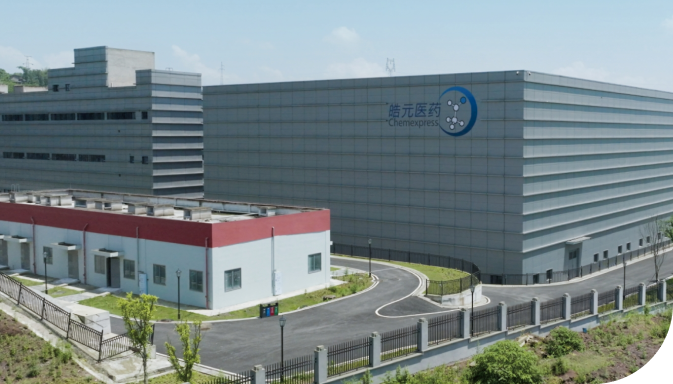
 XDC Research, Process Development and Manufacturing
Related Services

ADC Payload Linker
We specialize in complex and novel Payload-Linker, offering fully customized synthesis services to meet the specific needs of client projects.

ADC Drug Substance Process Developmentr
Partner with ChemExpress for cutting-edge, efficient ADC drug substance process development, from Payload-Linker synthesis to conjugation.

ADC Formulation Development
We align your pipeline with your preferred target product profile (TPP) through a comprehensive range of formulation development services, including aqueous injections and lyophilized formulations.

ADC Manufacturing
We provide cGMP-compliant bioconjugate manufacturing services for R&D, clinical and commercial stages, covering the entire ADC production process.

ADC Analytical Development & Quality Control
We are committed to offering complete analytical services for ADC drug development, covering key aspects like structural characterization, impurity analysis, microbial safety control , and stability study.
Case Study
ADC Sample Preparation – Bridged Cysteine Conjugation
ADC Sample Preparation – Bridged Cysteine Conjugation
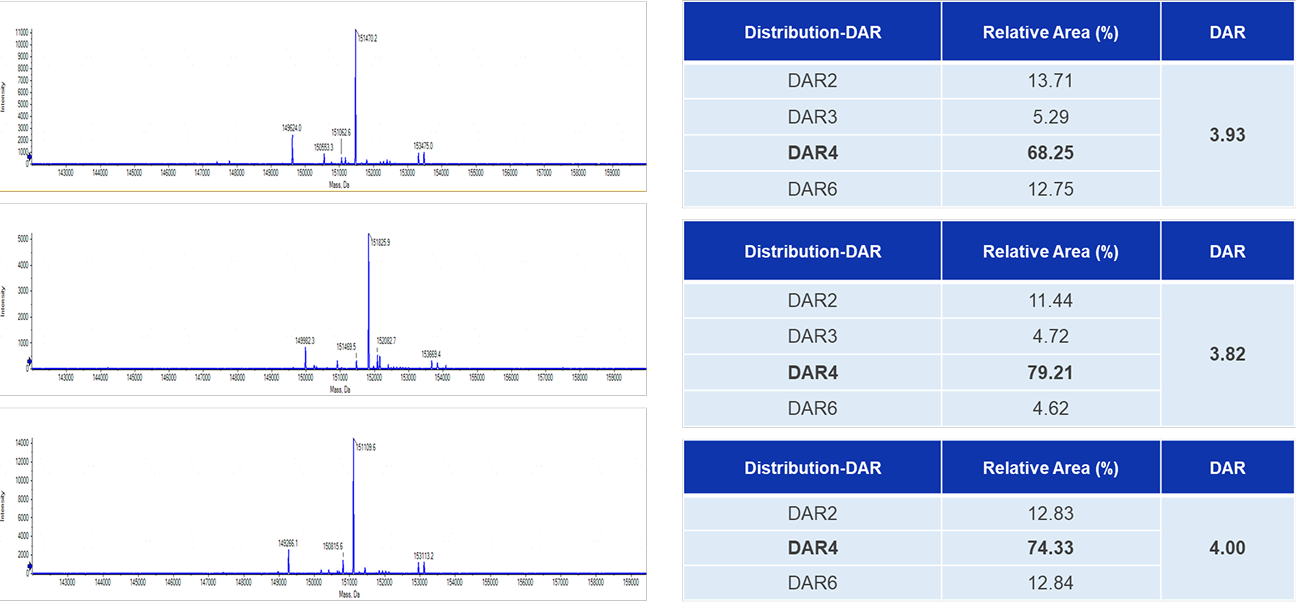
This study evaluated the applicability and consistency of bridged cysteine conjugation technology across different antibody systems.
Three different antibodies were conjugated using the same payload-linker system. Mass spectrometry analysis showed DAR values around 4, while the DAR distribution varied slightly among the different antibody scaffolds.
By optimizing conjugation parameters—including reductant equivalents, reaction time, and pH—ChemExpress improved the proportion of the DAR4 species, achieving a more uniform DAR distribution, providing a robust foundation for scale-up and platform process development.
FAQs
ChemExpress requires approximately 10 mg of antibody as the minimum starting material for a custom ADC conjugation request. All ADC samples delivered by ChemExpress undergo sterile filtration and endotoxin removal, ensuring that the final material meets sterility and low-endotoxin requirements.
· Based on the molecular weight difference between the payload linker and the antibody, purification methods such as ultrafiltration and size exclusion chromatography (SEC) can be leveraged for removal.
· When using site-specific conjugation techniques such as enzymatic conjugation or N-glycan conjugation, enzymes can be removed through purification processes like affinity chromatography.
· Based on differences in charge distribution and hydrophobicity, impurities can be removed using purification processes such as cation exchange chromatography (CEX), anion exchange chromatography (AEX), and hydrophobic interaction chromatography (HIC).
The thioether bond formed between maleimide and thiol groups may undergo retro-Michael addition in the presence of exogenous thiol-containing molecules, such as cysteine on serum albumin and glutathione (GSH). This instability may compromise the circulatory stability of the drug, increase off-target toxicity, and reduce the therapeutic efficacy of ADCs.
Solutions: Hydrolytic ring-opening or modifying the payload-linker (PL) by incorporating PEG or other modifications.
ChemExpress provide an integrated analytical platform including HIC, SEC-MS, LC–MS, and UV/Vis spectroscopy for DAR value, conjugation site identification, payload distribution analysis, free drug quantification, and residual impurities analysis. Method development and qualification are performed in alignment with ICH and FDA/EMA guidelines.


