

ADC Patent Strategy: From Molecular Innovation to Manufacturing Scale-Up
ADC Patent Strategy: From Molecular Innovation to Manufacturing Scale-Up
Antibody–drug conjugate (ADC) patent strategy involves more than identifying a novel structure. It requires adequate disclosure, evidence supporting the claimed technical benefits, and assessment of relevant third-party rights. For development teams, these considerations should inform experimental design and remain part of decision-making as molecules and manufacturing processes evolve.
Key Takeaways
Search beyond targets and payloads. Antibody designs, conjugation sites, linker–DAR combinations, conjugation methods, and key preparation steps may all be relevant to third-party patent rights.
Support structural changes with data. Use appropriate controls to evaluate linker, conjugation, or Fc modifications and establish which properties have improved.
Listing combinations is not sufficient disclosure. The December 2025 Seagen v. Daiichi Sankyo decision highlights the importance of written description and enablement across the claimed scope.
Revisit FTO as development progresses. Reassess freedom to operate when molecules or routes change, while building the batch data, impurity controls, DAR characterization, and documentation needed for scale-up and technology transfer.
On December 2, 2025, the US Court of Appeals for the Federal Circuit held the asserted claims in the Seagen v. Daiichi Sankyo litigation invalid for lack of adequate written description and enablement, and vacated the findings of willful infringement and the damages award. The lesson is that broadly enumerating possible combinations does not, by itself, support the corresponding claim scope. An application must describe the claimed invention and enable a person skilled in the art to make and use it without undue experimentation.[3]
Changing a linker, selecting a different conjugation site, or introducing a new payload may create opportunities for ADC innovation. Development teams still need to establish what those changes improve, which molecules the findings apply to, and whether product quality can be maintained at manufacturing scale.
In his 2026 Nature Biotechnology review, Ulrich Storz explains that the antibody, linker, and payload can each contribute to an ADC invention—and each may also implicate third-party patents.[1] Patent strategy should therefore be considered alongside experimental design and process development. Studies needed to establish a scalable process serve a different purpose from the disclosure required for patent protection and should be planned accordingly.
1 ADC Patent Searches Must Go Beyond the Target and Payload
The CAS report presents patent-family data for different antibody modalities from 2020 to 2025 and identifies continued interest in ADCs, bispecific antibodies, and multispecific formats.[2] The chart counts patent families by publication year; it does not directly measure the number of distinct drug candidates or their likelihood of clinical success.
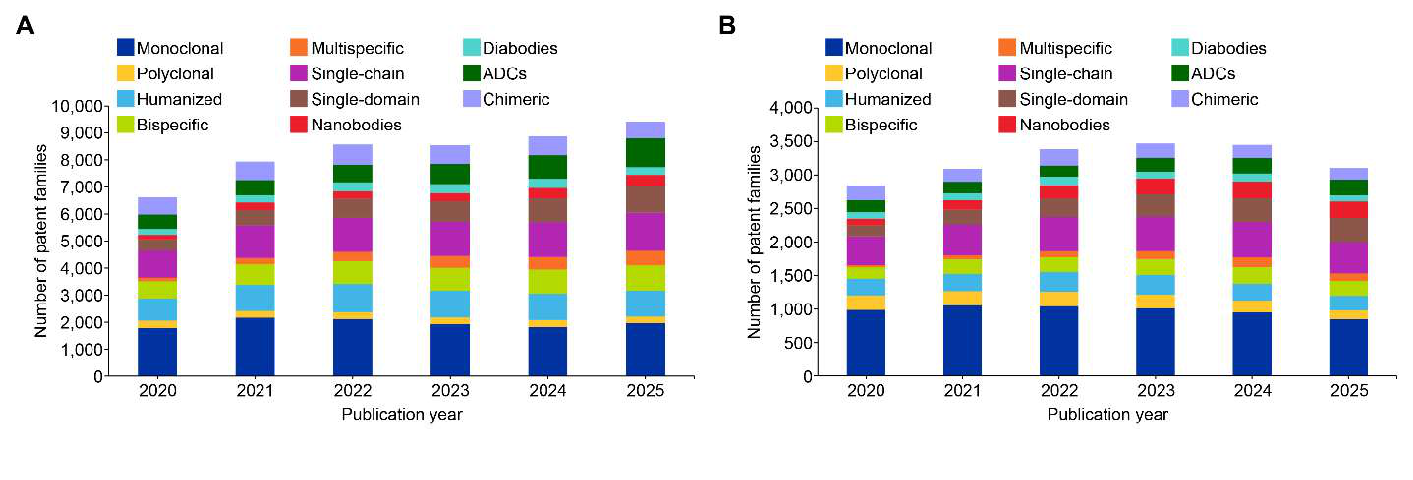
Figure 1. Patent distribution across antibody modalities. A, corporate enterprises; B, research and academic organizations. Source: CAS, Pharma patent landscape report, Figure 29, p. 86. Data cover 2020–2025.[2]
An ADC patent search should also consider how the components are combined. Antibody selection can affect conjugation-site options, while changes in payload hydrophobicity may require adjustments to the linker, drug-to-antibody ratio (DAR), or formulation. Searching only by target or payload class can miss patents directed to specific combinations and preparation methods.
At project initiation, development and IP teams can compile the proposed antibody sequence or epitope, Fc modifications, linker, payload, conjugation method, and key preparation steps. This gives the search a concrete basis in the technology the project intends to use.
2 Determine What Changed and Which Properties Improved
Storz identifies target applications, payloads, and specific ADC combinations as potential sources of innovation.[1] A structural difference, however, does not necessarily improve performance. Linker and conjugation changes can affect stability, release behavior, conjugation sites, and payload distribution, so comparisons should address the intended benefit.
Teams should define the property they intend to improve before selecting controls and endpoints. The following experimental-design considerations are this article’s interpretation of the literature, rather than findings reported in the review.
Table 1. Experimental considerations for evaluating ADC design changes
| Design objective | Key question | Suggested comparisons |
|---|---|---|
| Greater linker stability | Does the design balance stability in circulation with release under the intended conditions? | Stability, release behavior, and relevant functional measurements using the same antibody and payload. |
| Hydrophilic design for higher drug loading | How does increasing DAR affect solubility and stability? | DAR and its distribution, aggregation, solubility, and stability across designs. |
| More homogeneous site-specific conjugation | Is antibody function retained as homogeneity improves? | Conjugation-site identity, payload distribution, binding activity, and batch consistency. |
| Fc engineering | Do changes in effector function match the product design objectives? | Relevant Fc functions and intended effects, considered alongside the overall safety assessment. |
For example, a study of a hydrophilic linker can initially hold the antibody and payload constant, then examine the effect of different DARs. Changing several components simultaneously may make it difficult to identify the main reason for an improvement. Controls should help explain the benefit being claimed.
Site-specific conjugation can improve product homogeneity, but it does not by itself establish a clinical advantage. Similarly, whether a cleavable linker produces a bystander effect depends in part on the released species and its ability to cross cell membranes.[1] Conclusions should specify the conditions under which a benefit was observed.
3 Platform Claims Need Evidence for Their Proposed Scope
Supplementary Table 7 of the Storz review lists ADC platforms that have been licensed to multiple companies.[4] Synaffix, part of Lonza, provides an example of how platform technologies can support different targets and molecules. Its GlycoConnect and HydraSpace technologies are listed at platform level in the source; the technology modules licensed for individual projects may differ. Results from one candidate cannot automatically be generalized to other antibodies or payloads.
Table 2. Selected licensing examples involving Synaffix ADC technologies
| Licensor | Technology | Key patent | Licensee | Molecule | Target |
|---|---|---|---|---|---|
| Synaffix (now Lonza) | GlycoConnect™ HydraSpace | EP3912642 | Genmab | undisclosed | undisclosed |
| Amgen | undisclosed | undisclosed | |||
| Sotio | SOT109 | Undisclosed* | |||
| BigHat | undisclosed | undisclosed | |||
| Hummingbird | undisclosed | undisclosed | |||
| Mersana | XMT-1660 | B7-H4 | |||
| Elevation Oncology | undisclosed | undisclosed | |||
| Innovent | IBI343 | Claudin 18.2 | |||
| MacroGenics | MGC026 | B7-H3 | |||
| MacroGenics | MGC028 | ADAM9 | |||
| J&J | undisclosed | different targets | |||
| Kyowa Kirin | undisclosed | different targets | |||
| Kivu | KIVU-107、KIVU-305、KIVU-202 | different targets | |||
| AblBio | undisclosed | different targets | |||
| CKD Pharm | CKD-703 | c-Met | |||
|
NBE Therapeutics/ Boehringer Ingelheim |
undisclosed | different targets | |||
| Lepu Biopharma | MRG004A | tissue factor |
Source: Storz, Supplementary Table 7, pp. 11–12.[4] The source lists GlycoConnect/HydraSpace and EP3912642 as platform-level information; these entries should not be read as a complete statement of the technologies or patents licensed in each transaction. “Not disclosed in source” reflects the source table, not necessarily the current disclosure status. Company names follow that table. *SOT109’s target is updated to CDH17 (cadherin-17), disclosed by SOTIO in March 2025.[5]
As the Seagen case illustrates, listing many possible combinations is not the same as adequately describing the claimed invention or enabling its stated function.[3] If the proposed claims extend across multiple payloads, conjugation sites, or DAR ranges, representative combinations should be investigated to establish where the technology works. There is no universal number of experiments; the program should reflect the technology and the scope being sought.
Unsuccessful experiments also warrant internal documentation. Findings such as aggregation in particular combinations or altered release under certain conditions can clarify technical limitations. Whether to include those findings in an application is a matter for the filing strategy. Research supporting the central claims should be planned early: later data cannot simply be assumed to cure deficiencies in the original disclosure.
4 Reassess Freedom to Operate When Molecules or Processes Change
A granted patent does not establish freedom to operate (FTO). FTO analysis assesses whether specified activities—such as development, manufacture, or sale—may infringe valid, enforceable third-party rights. For ADCs, the assessment can encompass the antibody, linker, payload, preparation methods, and intermediates, with attention to the relevant jurisdiction and timing.[1]
As a project advances, teams may change an intermediate synthesis, introduce a new conjugation reagent, or modify the molecule itself. FTO should therefore be reviewed when the development candidate and key routes are selected, and following significant process changes, rather than relying solely on an assessment of an earlier design.
The expiry information in the review’s supplementary tables requires particular care. The author uses an approximate 21-year interval from the priority date and marks entries against a January 1, 2025 reference date.[1,4] This is the author’s estimation convention, not a universal statutory patent term. The dates and gray shading are search aids, not evidence that a technology is free to use. Relevant patent families, claims, legal status, and any applicable term adjustments or extensions still require examination.
Likewise, expiry of a foundational patent on an unconjugated antibody does not mean that an ADC incorporating that antibody is free of other patent constraints. FTO conclusions must relate to the particular jurisdiction, technical design, and activities under consideration.
5 Address Product Quality During Manufacturing Scale-Up
Patent examples explain how an invention can be carried out; a manufacturing process must consistently deliver the required product quality at the intended scale. During scale-up, teams need to examine process robustness, control of impurities and payload distribution, and whether process changes affect previously observed properties.
A contract development and manufacturing organization (CDMO) can support this work through process studies and traceable records. Linking sample and batch identifiers to structural characterization, purity, DAR and its distribution, aggregation, and stability results enables comparisons across batches and routes. These records also help investigate changes associated with raw materials, reaction conditions, or purification.
Technology-transfer documentation should clearly describe product quality requirements, process steps, and analytical methods so the receiving team can manufacture and test the product appropriately. Projects using external platforms should also establish whether the relevant licenses cover the intended manufacturing activities and contract manufacturing arrangements.
Collaborations should distinguish ownership of the customer’s molecule and project-generated IP from rights to use pre-existing and third-party technologies. Clear agreements can help prevent disputes during subsequent transfer and supply.
Applying Patent Insights to ADC Development
For technical teams, patent literature can help identify designs worth investigating, technologies requiring further searches, and issues to resolve before scale-up. Incorporating these questions into project planning may reduce the need for later changes.
ChemExpress supports ADC development through complex payload–linker synthesis, antibody process development and manufacturing, conjugation, formulation, and fill–finish services. With a commitment to customer ownership of IP relating to their innovative drug programs, ChemExpress uses process development and quality studies to help address practical challenges in synthesis, scale-up, and technology transfer.
References
[1] Storz U. An update on patent issues regarding antibody–drug conjugates. Nature Biotechnology. 2026;44:689–694.
[2] CAS. Pharma patent landscape report. Sections 5.1 and 5.1.1, pp. 86–88; Figure 29. Data period: 2020–2025. The supplied excerpt does not identify the report publication date or version.
[3] US Court of Appeals for the Federal Circuit. Seagen Inc. v. Daiichi Sankyo Company, Ltd. Nos. 2023-2424, 2024-1176. Opinion issued December 2, 2025.
[4] Storz U. Supplementary information to reference 1. Supplementary Table 7, pp. 11–12; additional patent tables and historical expiry estimates. Available with the article at
[5] SOTIO Biotech. SOTIO Unveils Promising Preclinical Data on SOT109, a Next-Gen ADC Targeting Cadherin-17 (CDH17) for Colorectal Cancer. March 3, 2025. Company announcement.